

Modern landscaping has quietly become one of the most tech-forward industries in home services. From AI-powered irrigation systems to drone-based lawn mapping, the tools available to homeowners and professionals today bear little resemblance to what was standard a decade ago. Whether you’re managing a small urban backyard or a sprawling residential property, understanding these innovations can save you money, conserve water, and produce noticeably better results.
This guide breaks down the most impactful technologies reshaping landscape maintenance — and how to put them to work for your property.
Smart Irrigation: The End of Overwatering
Overwatering is one of the most common and costly landscaping mistakes. Traditional sprinkler timers don’t account for rainfall, soil saturation, or seasonal temperature shifts. Smart irrigation controllers do all three.
Systems like Rachio and RainBird’s LNK WiFi Module connect to local weather data and adjust watering schedules automatically. If rain is forecast, the system skips a cycle. If a heat wave rolls in, it compensates by increasing run times. According to the EPA’s WaterSense program, smart controllers can reduce outdoor water use by 15% or more — a meaningful impact in drought-prone or water-restricted areas.
Soil moisture sensors add another layer. Devices like the Toro SMRT-Y measure actual moisture levels at the root zone and communicate with the irrigation controller in real time. The result: water delivered precisely when and where plants need it, not on a calendar schedule that ignores reality.
Robotic Lawn Mowers: Autonomous Upkeep
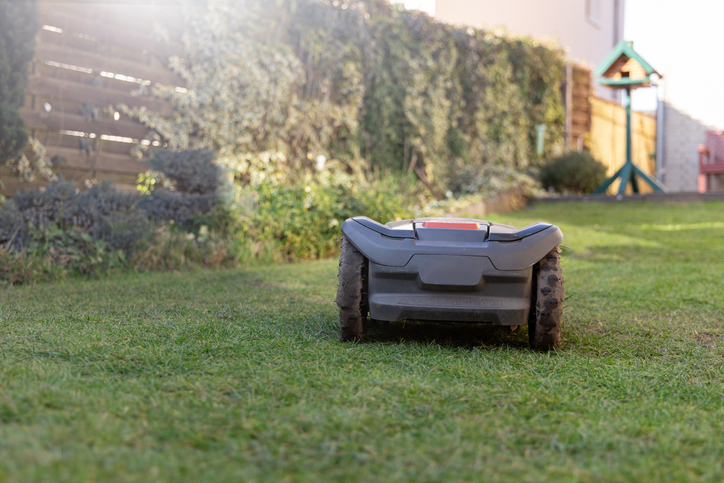
The robotic mower market has matured significantly. Today’s models — from Husqvarna’s Automower series to the Mammotion LUBA 2 — operate without buried perimeter wires, using GPS and camera-based navigation to map and mow complex lawn shapes.
These mowers run quietly, often at night, and mulch clippings finely enough to return nutrients to the soil — eliminating the need for bagging. Many integrate with smartphone apps that allow you to set schedules, monitor battery, and receive alerts if the mower encounters an obstacle or leaves its designated zone.
For properties with heavily segmented yards, steep slopes, or elaborate garden borders, robotic mowers aren’t quite plug-and-play. But for standard residential lawns, they represent a genuine shift: consistent, low-effort mowing without the noise or emissions of gas-powered equipment.
Drone Mapping and Aerial Assessment
Professional landscapers are increasingly using drones to assess large properties before design or renovation work begins. A drone flyover produces high-resolution topographic maps that reveal drainage patterns, slope gradients, bare spots, and irrigation coverage gaps that simply aren’t visible from ground level.
Software platforms like DroneDeploy process aerial imagery into detailed orthomosaic maps and 3D models. These tools help designers place features accurately, identify problem areas before they become expensive, and give homeowners a clearer picture of what they’re working with.
For ongoing maintenance, drone imagery captured across seasons helps track lawn health over time — flagging areas where turf is thinning, compaction is worsening, or pest pressure is building before visible damage sets in.
AI-Powered Plant and Pest Identification
Gone are the days of paging through field guides to identify a mystery weed or troublesome insect. Apps like iNaturalist and PictureThis use machine learning to identify plants, pests, and diseases from a smartphone photo — often within seconds.
This matters for landscape maintenance because early identification is everything. Catching a fungal infection in its early stages, before it spreads, is far less disruptive than treating an established outbreak. Knowing whether a grub population has crossed an action threshold helps homeowners and professionals make smarter decisions about when treatment is warranted and when it isn’t.
The University of Georgia Extension Service also offers diagnostic tools and expert guidance specific to southeastern growing conditions — a valuable resource for homeowners dealing with region-specific challenges like chinch bugs, dollar spot, or warm-season turf diseases.
Landscape Design Software and 3D Visualization
Before a single plant goes in the ground, today’s design tools let homeowners and professionals visualize the finished result in photorealistic detail. Platforms like PRO Landscape and Lands Design create 3D renderings that model sunlight angles, plant growth over time, and seasonal color shifts.
This capability changes the planning conversation. Instead of approving a design based on a hand-drawn sketch, homeowners can walk through a digital version of their yard — adjusting plant selections, hardscape materials, and layout — before committing to any work. It reduces costly mistakes and improves communication between clients and crews.
Some platforms are also beginning to integrate AI-assisted recommendations, suggesting plant palettes based on soil type, sun exposure, and regional climate data. For Atlanta-area homeowners navigating the transition between Piedmont clay soils and the specific drainage challenges of suburban neighborhoods, this kind of localized guidance can be particularly useful.
Soil Health Technology: Know What’s Underground
A lawn’s performance is largely determined by what’s happening beneath the surface. Soil testing has always been the foundation of good turf management, but the process has gotten considerably faster and more accessible.
Services like Yard Mastery and Logan Labs provide detailed soil analysis reports that go well beyond basic pH — measuring macro and micronutrient levels, organic matter content, and cation exchange capacity. Some platforms pair the results with custom fertilizer recommendations tailored to your specific turf type and soil profile.
For homeowners who want real-time data, wireless soil sensors from companies like Edyn can be placed directly in planting beds to monitor moisture, temperature, and fertility continuously, sending alerts to a smartphone when conditions shift.
Technology Meets Professional Expertise
Tools and apps can optimize a lot — but they work best when paired with skilled professionals who understand how to interpret data and act on it. Software can flag an irrigation inefficiency; it takes experience to know whether the fix is a nozzle adjustment, a zone redesign, or a drainage correction.
For Atlanta homeowners, working with a professional service that incorporates these technologies into their workflow makes a real difference. Quality landscape maintenance services for Atlanta homes combine hands-on expertise with modern tools to keep turf, beds, and hardscape performing well through Georgia’s demanding climate — from summer heat stress to early spring fungal pressure.
The best outcomes come from using technology as a force multiplier for skilled work, not a replacement for it.
Sustainable Landscaping Through Smarter Technology
One of the most meaningful benefits of tech-forward landscaping is the environmental payoff. Precision irrigation reduces water waste. Electric and battery-powered equipment cuts noise and emissions. Soil testing reduces over-fertilization, keeping excess nutrients out of stormwater runoff.
The Sustainable Sites Initiative provides a framework for evaluating and improving the ecological performance of landscapes — a useful benchmark for homeowners interested in measuring their impact. The National Wildlife Federation’s Garden for Wildlife program also offers guidance on designing landscapes that actively support pollinators and native species, using plant selection tools searchable by zip code.
Technology doesn’t have to mean high-maintenance systems. Sometimes the smartest upgrade is switching to native plantings that require minimal irrigation and care once established — reducing both inputs and labor over the long term.
What to Look for in a Tech-Savvy Landscape Professional
Not every landscaping company has embraced these innovations equally. When evaluating providers, a few questions are worth asking:
- Do they use soil testing as a baseline for fertilization programs, or apply based on a fixed schedule?
- Are their irrigation systems smart-controller compatible, and do they offer seasonal audits?
- Can they provide plant health assessments using diagnostic tools rather than visual guessing?
- Do they offer any documentation or reporting on services performed?
A professional who can answer these questions specifically — not generically — is one who has genuinely integrated technology into their practice rather than treating it as a marketing talking point.
Wrapping Up
The intersection of technology and landscaping is no longer a niche conversation. Smart irrigation, robotic equipment, AI diagnostics, and precision soil science are mainstream tools that meaningfully improve outcomes for homeowners willing to engage with them. The learning curve is modest, the payoff is real, and the environmental benefits make a strong case for adoption.
Whether you’re managing your lawn independently or working with a professional service, understanding what these tools do — and what they don’t — puts you in a better position to ask the right questions and make smarter decisions for your property.