
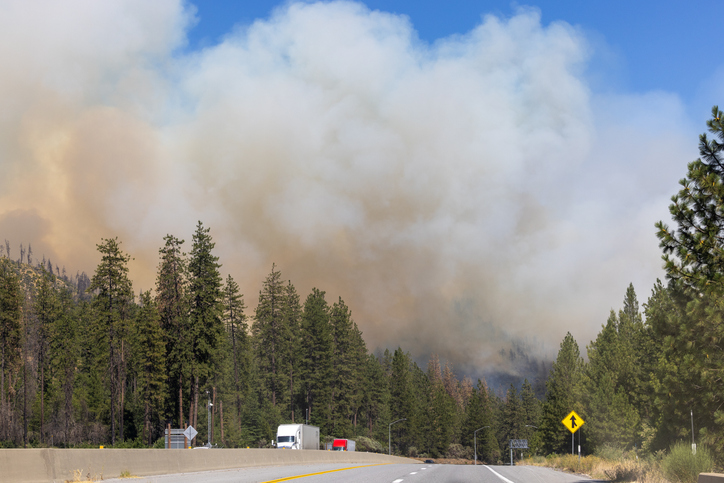

You’ve driven this stretch of highway a hundred times. Then one afternoon in late summer, the sky turns the color of a nicotine stain, the sun goes orange, and the air starts to smell like a campfire that got out of hand. Visibility drops from a mile to a few hundred feet to, somewhere up ahead, almost nothing. You slow down. The car behind you slows down. And the fully loaded 80,000-pound tractor-trailer three vehicles back — the one whose driver is on hour nine of a shift, staring into the same gray wall you are — needs up to two football fields of road to come to a stop.
That gap, between what you can see and what a semi-truck can do about it, is where some of California’s worst chain-reaction crashes are born. And as wildfire season stretches longer every year, it’s a gap that’s getting harder to ignore.
The physics nobody teaches you in driver’s ed
Here’s the part that makes wildfire smoke so much more dangerous when big trucks are in the mix: a loaded semi doesn’t stop like your sedan. According to the Federal Motor Carrier Safety Administration, a fully loaded truck traveling at highway speed can need the length of up to two football fields to stop — and that’s on dry pavement, with a rested driver, with clear sight lines.
Now take away the sight lines. When smoke cuts visibility to 200 feet, a truck driver may physically not have enough room to stop by the time a hazard appears out of the haze. The driver isn’t necessarily reckless. The math simply doesn’t work. A car can brake hard and tuck into a gap. Forty tons of freight moving at 60 miles an hour cannot.
And trucks don’t just fail to stop — they change the whole character of a crash. When a semi plows into slowing traffic, it doesn’t add one more damaged car to the pile. It jackknifes across lanes, it pushes vehicles into each other, and if it’s carrying fuel or hauling something flammable, it can turn a fender-bender into a fire. California has watched this exact sequence play out on the Cajon Pass, where dozens of cars and tractor-trailers once piled up in a fog-shrouded, fiery chain of collisions along a two-mile stretch, with multiple trucks jackknifed and several vehicles engulfed in flames.
This isn’t a freak occurrence. There’s a pattern.
It’s tempting to file low-visibility pileups under “acts of God” — bad luck, bad weather, nothing to be done. The data says otherwise.
Researchers who studied motor vehicle crashes during California wildfire smoke events from 2010 to 2020 found what common sense suggests but rarely gets measured: crash risk climbs when smoke moves in. Smoke belongs to the same dangerous family as dense fog, blowing dust, and sandstorms — all of them low-visibility conditions that decades of crash research link to a spike in collisions. California sees the fog version almost every winter in the Central Valley, where a single January morning produced a 40-plus-vehicle pileup near Bakersfield in visibility estimated at 50 to 60 feet, with semis and passenger cars mangled together across all lanes. Swap the fog for wildfire smoke and the physics are identical. The only thing that changes is the season.
That’s the uncomfortable truth about smoke on California highways: it’s not rare, it’s not random, and it disproportionately shows up in exactly the rural, high-speed corridors — the I-5 through the Grapevine, the 15 over the Cajon Pass, the 99 up the valley — where heavy trucks run bumper to bumper hauling freight between the ports and the rest of the country.
“I couldn’t see” is not the end of the story
Here’s where a lot of drivers get it wrong, and where it pays to understand how the law actually works.
California’s basic speed law doesn’t just say “obey the posted limit.” It says you can’t drive faster than is reasonable or prudent for the conditions — with due regard for weather and visibility — and smoke is very much a condition. In plain terms: when the smoke rolls in and everyone is still doing 65, the posted speed limit stops being your permission slip. A driver who barrels into a smoke bank at highway speed and rear-ends slowing traffic can be found at fault even if they never technically “sped.”
For commercial truck drivers, the bar sits higher still. Professional drivers are trained and expected to adjust for weather, and the companies they work for operate under a thick layer of state and federal safety rules — hours-of-service limits meant to keep exhausted drivers off the road, maintenance requirements, and more. When a truck is involved in a smoke-related pileup, the questions multiply fast: Was the driver over their allowed hours? Should the load have been on the road at all under a smoke advisory? Were the brakes maintained? That’s why crashes involving a big rig play out so differently from a two-car fender-bender. There’s a company behind the driver, an insurance policy sized for catastrophe, and a paper trail — logbooks, maintenance records, the truck’s onboard data — that tells a story about whether “I couldn’t see” was bad luck or preventable negligence. Untangling that paper trail is exactly the kind of work Banner Attorneys handle for people hurt in truck crashes along the I-15 and Cajon Pass corridor near Fontana.
None of that erases the smoke. It just means that when 40 tons meets a wall of gray at freeway speed, “the weather did it” is rarely the whole answer.
What you can actually do when the sky turns orange
You can’t control the wildfire, and you certainly can’t control the semi behind you. But you can shrink your own risk when visibility collapses:
- Slow down before you feel like you have to. By the time smoke feels dangerous, you’re already in it. Ease off early and increase your following distance dramatically — you want room to react to something you can’t yet see.
- Get out of a truck’s blind spots and stopping zone. If you can’t see a big rig’s mirrors, its driver can’t see you. In low visibility, don’t linger directly in front of a loaded semi where its stopping distance becomes your problem.
- Don’t rely on automatic headlights. In heavy smoke and fog, “auto” settings can leave your lights off. Turn them on manually — low beams, not high, since high beams bounce off smoke and make things worse.
- If you have to stop, get all the way off the road. A car halted in a live lane in near-zero visibility is the seed of the next pileup. Pull well onto the shoulder or off an exit, and get away from the vehicle.
- When in doubt, wait it out. A gas station, a rest stop, an off-ramp — pausing for 20 minutes until a smoke bank passes beats becoming vehicle number 44.
Wildfire smoke is going to be part of the California driving calendar for the foreseeable future. The big rigs aren’t going anywhere either — they’re the freight backbone of the whole state. Knowing how those two facts collide, and giving yourself room when the sky goes orange, is one of the few parts of this you actually get to control.